
What you can do
Make to recipe, batch after batch
Plan, produce and record every batch — from a single brew to multi-step production chains — without losing track of what went into what.
How it works
From recipe to finished batch
Set your recipe
Define ingredients, quantities and steps once. Scale it up or down per run.
Run the production order
Record what you made, when, and which input batches you used — with activity logs as you go.
Get a traceable batch
Every finished batch links back to its inputs automatically, ready for traceability and labelling.
What powers it
Built for how producers actually work
The production tools small makers need — nothing heavier.
- Recipes with flexible scaling
- Production orders with activity logging
- Multi-step production flows
- AI drafts a production order from a plain-language note
- Yields, waste and by-products captured
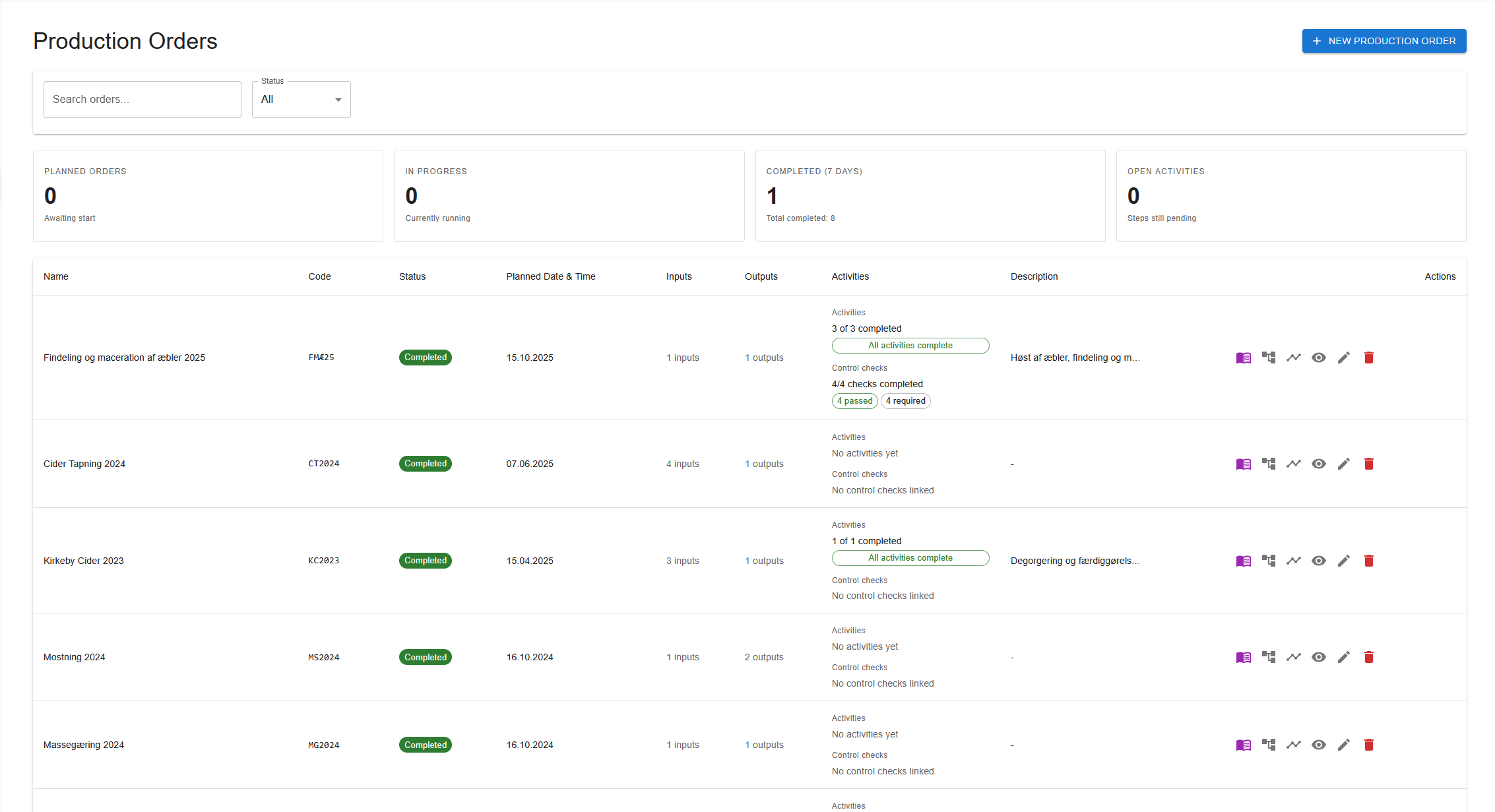
A production order is one document, both halves
Most of the damage we see in reconstructed records comes from half-booked production: the raw materials were picked, the result never got entered, and the gap only shows up months later as a stock figure nobody can explain. In fermt an order carries its inputs and its outputs together, so the material that left and the goods that arrived are recorded in the same act rather than in two systems that have to be reconciled afterwards.
Recipes drive it. A recipe names input products and quantities, expected yields, and optionally the process activities that go with them, so an order starts from what you already decided rather than from a blank form. A recipe can also have several outputs, which is what a press yielding juice and pomace, or a cut yielding spirit and feints, actually needs.
- Inputs, outputs, activities and labour on one order
- Recipes with expected yields and multiple outputs for co-products
- Production costs captured as the order runs
- Batch created on output, with full lineage back to the inputs
Flows, for work that takes more than one step
Few things are made in a single operation. A production flow chains several orders into one managed workflow and can generate the chain from the product's recipe tree, so a multi-stage make — mash, ferment, distil, fill — is planned and tracked as one thing while remaining a series of properly recorded orders underneath.
Each step can carry a process template: reusable steps, parameters and quality checkpoints, including the HACCP plan for that stage. The checks reach the operator on the step they are working on, which is the difference between a plan that is followed and a plan that lives in a binder.
What is coming, on one calendar
Planned production orders appear on the dashboard calendar alongside goods receipts, purchase and sales orders, waste events and invoices, so the week reads as one picture rather than six screens. Scheduled tasks sit on the same calendar and can recur on a monthly interval, which is where the jobs that are easy to forget belong: a certificate renewal, a quarterly plan review, a cask check.
Age that survives a transfer
Spirit moves. It goes into one cask, comes out, waits in a vat, goes into another. fermt counts maturation only across time spent in vessels tagged as maturation, so moving a spirit does not reset its clock and a gap outside a cask does not quietly count towards it. The age is worked out when the production order completes, by walking back through every batch that fed it.
That matters because age is a legal claim rather than a description. A number that came from a spreadsheet is only as reliable as whoever kept the spreadsheet; one that came from the movements gives the same answer every time it is asked, including years later when the person who filled the cask has left.
- Maturation counted only in vessels marked for it
- A transfer between casks continues the age rather than restarting it
- Age computed from the provenance chain, not typed in
- A minimum legal age can be set per product
Questions we get
Production questions we get asked
Can one order produce more than one product?
Yes. Recipes support several outputs, so co-products and by-products are recorded on the order that made them instead of being adjusted in afterwards. A press yielding juice and pomace is one order with two outputs.
How do multi-stage productions work?
As a production flow: several orders chained into one workflow, which fermt can generate from the recipe tree. You keep a single view of progress while each stage remains a proper order with its own inputs, outputs and batch.
Where do quality checks live?
On process templates attached to the step. A template holds reusable steps, parameters and quality checkpoints, including HACCP plans, so the checks appear on the step being worked rather than in separate paperwork.
Do we get production costs?
Yes. Orders capture activities and labour alongside material consumption, which feeds unit cost. Inventory valuation then values the resulting batches at what they actually cost, so the cost of what you made carries through to what you hold.
What if a production is entered wrong?
There is a guided stock correction path that walks you through whether the right answer is a reversal, an adjustment or a waste record, and every route leaves an audit trail. Nothing is silently overwritten.
Who relies on this
Crafts that lean on this most
Ready to get out of spreadsheets?
Start your free trial today, or talk to us about your setup.