
Built around your craft
Software for craft distilleries
From new-make spirit to bottled age-statement — track every cask, transfer and blend, with legal age and alcohol reporting handled.
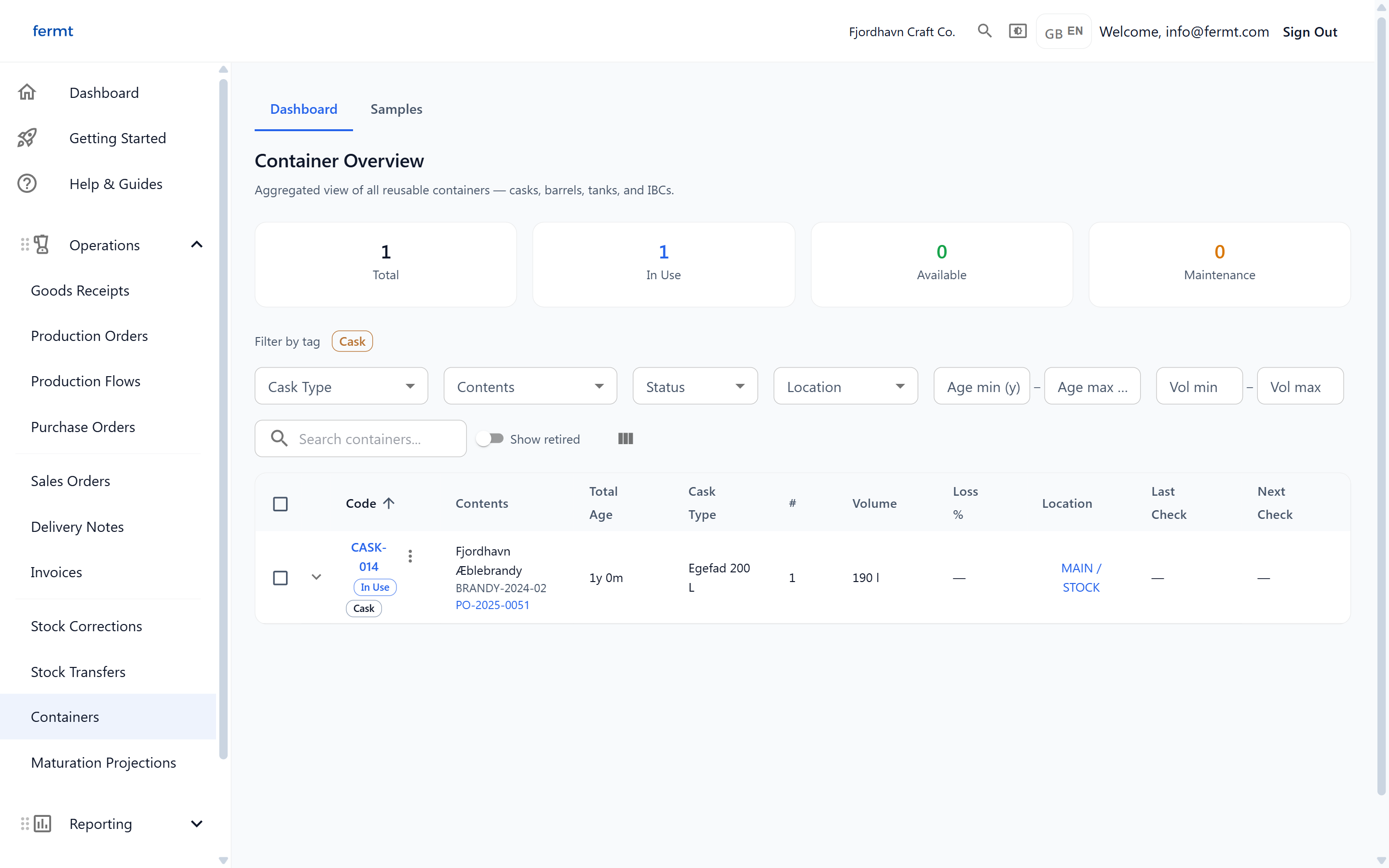
Your workflow in fermt
Your distillery, end to end
Distill & fill
Record production and fill spirit into casks, batch-tracked from the start.
Learn moreStay compliant
Alcohol reporting and legal age computed from the maturation chain — not a spreadsheet.
Learn moreBottle with a story
Auto-fill QR labels with cask provenance and age the moment you bottle.
Learn moreReal cask management
Track maturation age across transfers and blends, compute angels' share and projected loss, see ready-to-bottle dates, and keep full blend lineage — the things generic inventory tools simply don't model.
Compliance, handled
Alcohol & age, handled
Legal maturation age is computed from the cask chain (youngest component for blends), with alcohol/excise reporting and minimum-age checks built in.
The cask is the unit of work, so it is the unit of record
A spirit spends most of its life doing nothing visible, in a vessel that slowly gives some of it back to the air. Systems built around finished goods handle that badly: the stock figure is right on the day you fill and wrong every day after. In fermt a cask is a tracked container with its own history — every fill, empty and regauge is a movement against the batch inside it, so the volume in the system moves as the volume in the warehouse moves.
That history is what makes loss measurable rather than assumed. The container loss report shows the angels' share per cask and per cohort, and because casks are grouped by cooperage, the annualised rate for a new cask is derived from its siblings rather than guessed from an industry average. A cask losing noticeably more than its cohort is visible as a number, not as a surprise at bottling.
- Fill, empty and regauge history per cask, tied to the batch inside
- Angels' share by cask and by cooperage cohort
- Projected volume at minimum age, and days remaining until a spirit reaches it
- Next-check dates and current contents on one dashboard
An age statement you can prove, or refuse to print
An age statement is a legal claim about the youngest spirit in the bottle. fermt computes maturation age from the batch's own container history, so the age comes from when the spirit actually entered wood — not from a date typed on a product record.
Products carry a minimum maturation period, and completing a production order checks the output against it. You choose the strictness: a warning that surfaces on the order, or a hard block that refuses to complete it. Most distilleries run it as a warning while they build confidence and then turn on enforcement, which is why it is a setting rather than a rule.
Duty on what you actually filled
Excise is charged on pure alcohol, and pure alcohol is volume times strength. fermt resolves the effective ABV per batch, falling back to the product's standard strength only when the batch has no measurement of its own — so a cask that came out of the warehouse at a different strength than the last one reports at the strength it actually had.
Volumes are bucketed into your own duty bands. The Danish bands are the default; a distillery in another market configures its own, and everything that falls outside every band is reported as an explicit out-of-band line rather than being quietly dropped into the nearest one.
Questions we get
Distilling questions we get asked
Can fermt handle regauging and part-filled casks?
Yes. A regauge is a movement against the cask like any fill or empty, so the running volume reflects it immediately and the loss report accounts for it rather than treating the difference as evaporation. Part-filled casks and blends across several casks both come out of the same container history.
How is the angels' share calculated?
From the cask's own fill and regauge history, annualised. Where a cask is too new to have a meaningful rate of its own, fermt uses the cohort of casks from the same cooperage, which is a far better estimate than an industry average because it reflects your warehouse and your wood.
What happens if we try to bottle a spirit that is too young?
That depends on how you have set it. By default the production order completes and raises an advisory naming the shortfall. Turn on enforcement and the same check blocks completion instead. The check uses the output product's minimum maturation period and the batch's real age in wood.
Does this cover EMCS and duty filing?
fermt produces the figures the filing needs — volume and pure alcohol by duty band, from batch-level ABV — and the movements behind them are traceable to the casks and orders they came from. Submission still happens in your national system; what fermt removes is the spreadsheet that used to sit in front of it.
We also bottle for others. Does contract work fit?
Yes. Casks belong to batches and batches belong to production orders, so spirit you hold for someone else stays distinguishable from your own stock, with its own age, losses and movement history.
Run your distillery on fermt
Start your free trial today, or talk to us about your setup.