
Built around your craft
Software for cideries and meaderies
From fruit or honey intake to packaged lot, with duty calculated on the strength you actually fermented and every pallet traceable to the growers it came from.
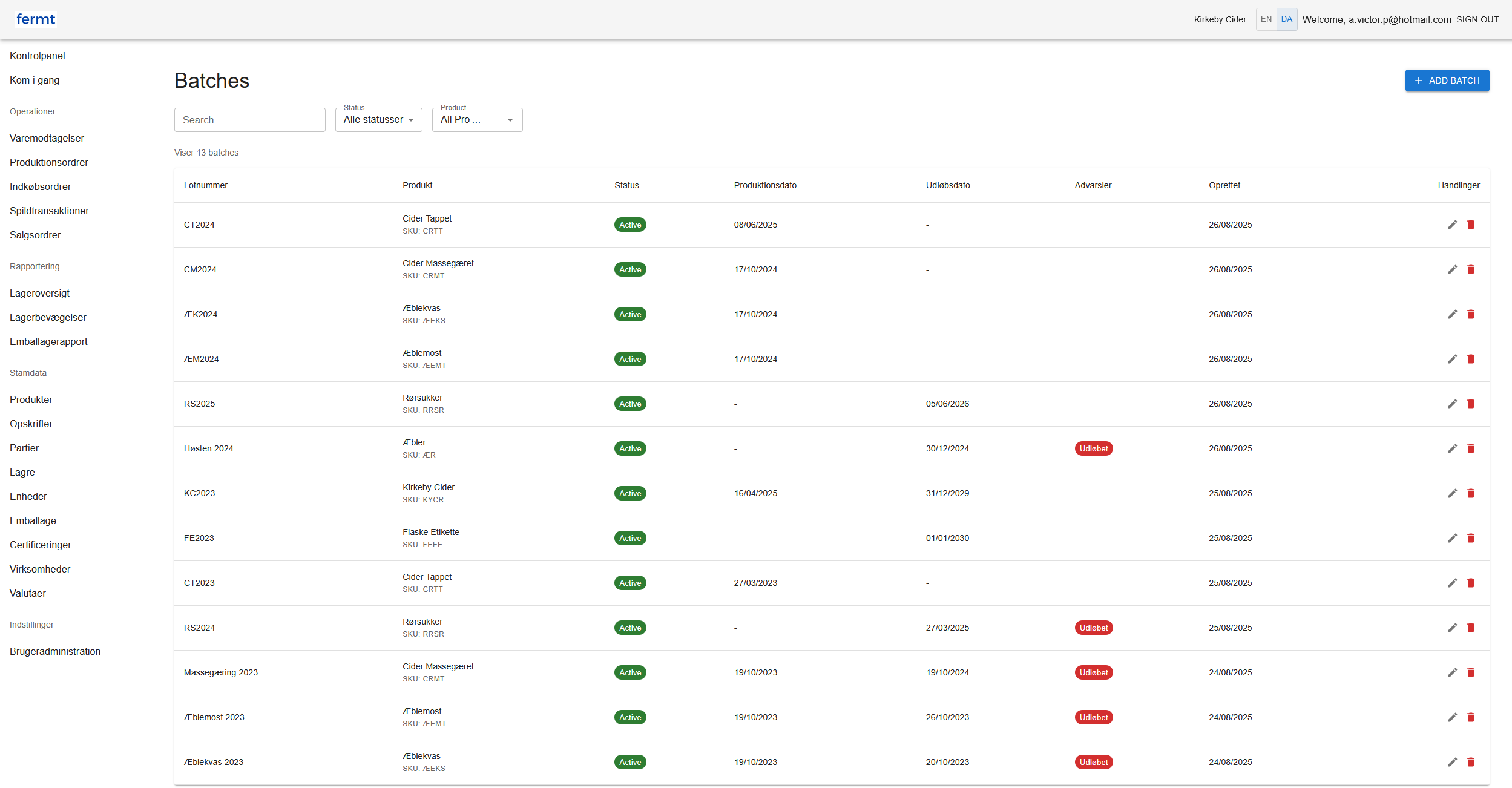
Your workflow in fermt
Your cidery, end to end
Aging & blends, tracked
Track cider aging in tanks and casks, manage blends across batches, and keep the provenance that sets craft cider apart.
Compliance, handled
Organic & alcohol, handled
Keep an auditable organic balance and alcohol reporting without extra paperwork.
Duty follows the strength you fermented, not the one on the label
Cider and mead are the awkward cases for duty. A brewery repeating the same recipe every week can lean on a standard strength; a cidery cannot, because the fruit decides. Press a sharper year and the same recipe finishes somewhere else entirely, and mead moves further still with the honey and the length of the ferment.
fermt resolves the effective ABV per batch and falls back to the product's standard strength only when the batch has no measurement of its own. Volumes are then bucketed into your own duty bands, with the pure alcohol volume and average strength calculated per band. Anything falling outside every band is reported as an explicit out-of-band line, because a volume quietly rounded into a neighbouring band is exactly what surfaces awkwardly in an audit.
- Batch-measured ABV preferred over the product's nominal strength
- Configurable duty bands, defaulting to the Danish ones
- Pure alcohol volume and average ABV per band
- Out-of-band volumes reported explicitly, never rounded into a neighbour
A season arrives all at once
Fruit intake is not a steady flow of deliveries. It is a few intense weeks where several growers arrive on the same day, and the paperwork done then decides whether you can answer a question in March about which orchard went into which tank. Goods receipts record the intake against supplier and lot, and the batch carries that link forward through pressing, fermentation and packaging.
Honey behaves the same way for a meadery, with fewer and larger lots and a longer ferment in between. In both cases the useful property is identical: a finished pallet traces back to the raw lots it came from without anyone reconstructing it from memory.
Where cideries and meaderies differ
These two crafts share a page because they share a system: the same fermentation spine, the same duty mechanics, the same traceability from raw lot to pallet. Where they part company is worth naming.
- Cideries: seasonal intake from many growers, wide year-on-year ABV variance, several varieties often blended into one lot, and pomace as a by-product worth recording as waste or a co-product.
- Meaderies: fewer and larger honey lots with a long shelf life, ferments that run for months and therefore straddle reporting periods, small batch sizes where one vessel is a whole production run, and a range that varies more by adjunct than by base.
Questions we get
Cidery and meadery questions we get asked
Our ABV moves between batches. Does that break duty reporting?
No, it is the case this is built for. The duty figures use the batch's measured strength wherever there is one, so a variable ferment reports at what it actually was. The product's standard strength is only a fallback for batches with no measurement of their own.
Can we trace a finished pallet back to the orchard?
Yes, provided the intake was recorded against supplier and lot at goods receipt. From there the chain runs through pressing, fermentation and packaging as ordinary batch traceability, in both directions.
We make mead, not cider. Is this page for us?
Yes. The two share a system, so they share a page rather than each getting a thinner one. The section above sets out where they differ in practice, and nothing described here is cider-only.
How do we handle a ferment that runs across a reporting period?
The batch stays open in the vessel and movements sit on the dates they happened, so a period report shows the material as work in progress rather than as finished stock. This matters more for mead than cider, where a ferment can easily straddle two periods.
What about pomace and other by-products?
Record it as a co-product on the production order if it has value, or as waste if it does not. A recipe can carry several outputs, so a press yielding juice and pomace is one order with two outputs rather than a fudge.
Run your cidery on fermt
Start your free trial today, or talk to us about your setup.