
Built around your craft
Software for craft chocolate makers
Roast, winnow, grind, conch, temper and mould — every stage its own batch, so a finished bar traces back to the sack of beans it came from and the organic accounts add up.
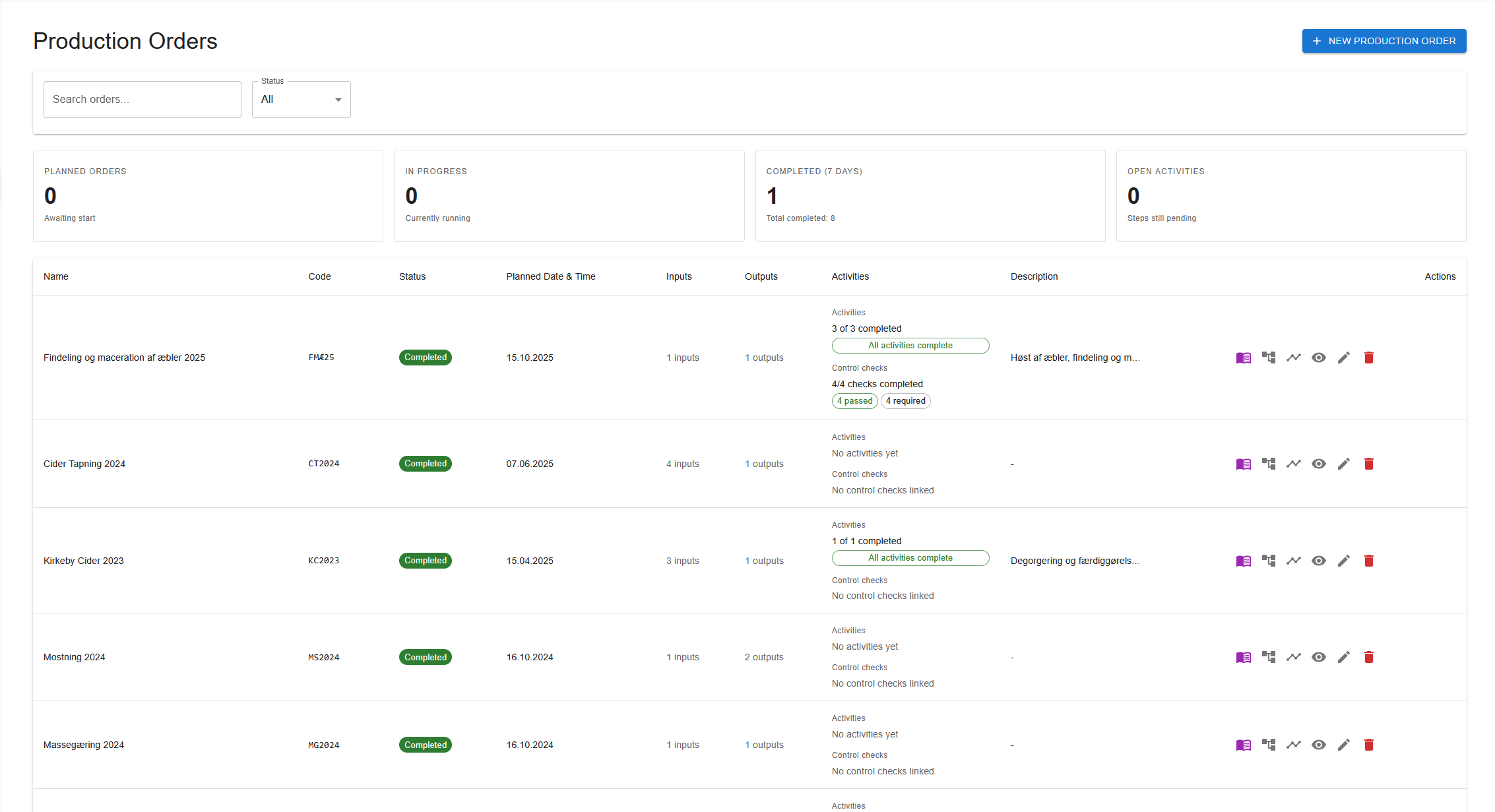
Your workflow in fermt
Your chocolate, end to end
Make in stages
Each step is its own order and its own batch, chained from the recipe tree.
Learn moreTrace bean to bar
A finished bar resolves back to the origin lot, and forward to every customer.
Learn moreBalance the organics
The organic accounts come out of the same production records, for any period.
Learn moreA chain that survives six transformations
Beans become nibs become liquor become couverture become a moulded bar in a box, losing weight at every step. fermt keeps a batch at each stage with its lineage intact, so the trace holds all the way through and the yield loss is a measured figure rather than the gap left over at the end.
Compliance, handled
Organic accounts that close
Opening, receipts, what production consumed and made, sales, waste and closing — per raw material and per finished product, with the difference against your physical count, for whatever period the inspector asks for.
Weight disappears at every stage, and it has to be accounted for
Chocolate is one of the longest transformation chains in small-scale food. A sack of beans is roasted, winnowed into nibs and shell, ground, conched for days, tempered, moulded and boxed — and mass leaves at nearly every step. A system that treats the finished bar as the unit of record cannot tell you where it went.
In fermt each stage is its own production order producing its own batch, chained from the recipe tree, so the nibs know which beans they came from and the bar knows which batch of couverture went into it. Yield per stage is then a figure you can look at rather than a residual you discover at stocktake. Where one run produces two saleable things — nibs and cocoa butter, say — a recipe with several outputs records both on the order that made them.
- A batch at every stage, from bean lot to moulded bar
- Yield and loss measured per step, not inferred at the end
- Recipes with several outputs for nibs, butter and shell
- Cost carried forward from the bean price, through every stage
Organic and origin are the same question asked twice
Most craft chocolate is sold on two claims at once: it is organic, and it comes from a named origin. Both are answered by the same records. Organic status sits on the product, so the balance separates organic from conventional without a second set of books; the origin is the goods receipt that created the bean lot, and the trace runs forward from it.
The balance itself is the document an inspection turns on. fermt renders it per product for any period — opening, receipts, consumption, production, sales, waste, closing — and measures the difference against everything that moved through the product rather than against the closing stock, so a few kilos across several tonnes of throughput reads as the rounding it is.
Questions we get
Chocolate questions we get asked
Can fermt follow a bar back to the bean sack?
Yes, provided the intake was recorded against the supplier and lot at goods receipt. From there each stage links its output batch to the batches it consumed, so the trace walks back through moulding, tempering, conching, grinding and roasting to the origin lot — and forward to every customer who received that bar.
How do we handle the weight lost in roasting and winnowing?
As the difference between the order's inputs and its outputs, which is recorded rather than assumed. Shell can be an output in its own right if you sell or compost it, or a waste record if not. Either way the loss belongs to the order that caused it, which is what makes a yield figure meaningful.
Does the organic balance handle a chain this long?
Yes — it reads the production records, so every stage contributes. Note that the balance is per product: beans, nibs, liquor and the finished bar each get their own line, which is what an inspector expects rather than a single figure for the chocolate.
We make filled and moulded lines from the same couverture. Does that work?
Yes. One batch of couverture can feed several production orders, each creating its own finished batch, and the trace records which bar came from which conche. That is the same mechanism a distillery uses to bottle one cask into several products.
Can we reconstruct a past period for an inspection?
Yes. Documents are entered dated to when they happened rather than to the day they were typed, and the balance for that period comes out the same way as for a period recorded live.
Run your chocolate production on fermt
Start your free trial today, or talk to us about your setup.